

How Does Lactic Acid Fermented Corn Silage Improve Feed Quality and Storage?
2026-09-08
Lactic Acid Fermented Corn Silage is an increasingly important feed solution for modern livestock farming because it combines the nutritional value of whole-plant corn with controlled lactic acid fermentation. During ensiling, naturally occurring or added lactic acid bacteria convert water-soluble carbohydrates into organic acids, especially lactic acid. This process rapidly lowers pH, suppresses undesirable microorganisms, and helps preserve valuable nutrients for a longer storage period.
For dairy farms, beef cattle operations, feed producers, and agricultural distributors, choosing properly processed silage can directly influence feed utilization, storage efficiency, and livestock feeding management. Hebei Yiman Agricultural Technology Co., Ltd. focuses on agricultural technology and feed-related solutions, providing practical options for customers who need reliable fermentation products and flexible customization, including ship-shaped customization for specific application, packaging, transportation, or presentation requirements.
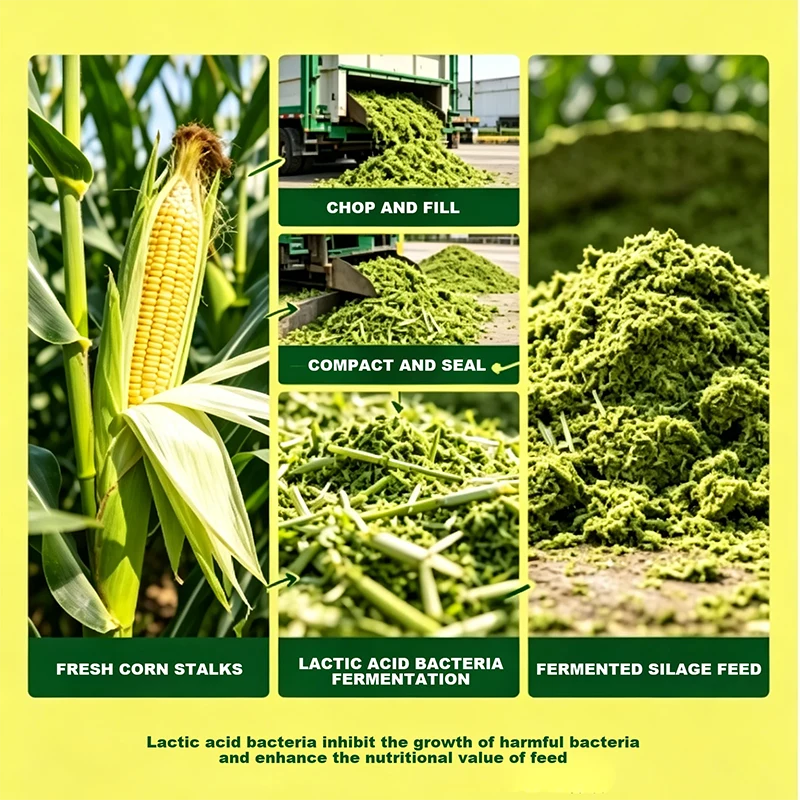
What Makes Lactic Acid Fermented Corn Silage Different?
The key difference is the controlled fermentation process. Fresh corn contains fermentable sugars that can serve as substrates for lactic acid bacteria. When oxygen is removed and anaerobic conditions are maintained, desirable bacteria multiply and convert these sugars into lactic acid.
Lactic acid is particularly effective because it can reduce silage pH quickly. Under suitable ensiling conditions, high-quality corn silage can reach a stable pH of around 4.0 or lower during the early fermentation stage.
This process provides several important effects:
-
Rapid pH reduction: Helps inhibit many undesirable microorganisms.
-
Nutrient preservation: Reduces fermentation losses when ensiling is properly managed.
-
Improved feed stability: Supports better preservation during storage.
-
Good palatability: Properly fermented silage can have a desirable fermented aroma and feeding characteristics.
-
Better fiber utilization: Research indicates that selected lactic acid bacteria can contribute to improved fiber digestibility.
Why Is Lactic Acid Fermentation Important?
The primary objective of silage fermentation is not simply to make corn acidic. It is to preserve the crop's nutrients while minimizing dry matter and energy losses.
Poor fermentation may leave excessive residual sugars, encourage undesirable microorganisms, increase ammonia nitrogen, or create conditions for yeast and mold growth. Oxygen exposure after opening can also accelerate deterioration because aerobic microorganisms consume fermentation acids and other nutrients.
By contrast, effective lactic acid fermentation helps create a more stable preservation environment.
| Factor | Properly Fermented Corn Silage | Poorly Managed Silage |
|---|---|---|
| Fermentation | Dominated by desirable bacteria | Unbalanced microbial activity |
| pH | Rapidly reduced | Slow or unstable reduction |
| Nutrient retention | Generally better | Greater risk of losses |
| Feed quality | More consistent | More variable |
| Storage | Better preservation potential | Higher spoilage risk |
| Feeding management | Easier to manage | More frequent quality concerns |
What Are the Main Uses and Effects?
Lactic Acid Fermented Corn Silage is widely used as a forage component for dairy cattle and beef cattle. Corn provides readily available carbohydrates and energy, while the fermentation process makes the crop suitable for long-term preservation.
1. Dairy Cattle Feeding
Corn silage is commonly incorporated into dairy cattle rations because of its energy contribution and forage characteristics. Proper fermentation can help maintain consistent feed quality throughout the feeding season.
However, fermentation quality alone should not be considered a guarantee of increased milk production. Research shows that responses to microbial inoculants can vary according to bacterial strain, crop characteristics, fermentation conditions, and farm management.
2. Beef Cattle Feeding
For beef cattle, fermented corn silage can provide an economical source of forage energy. A consistent silage supply can simplify ration formulation and support efficient feeding management.
3. Long-Term Feed Preservation
One of the greatest advantages of silage is its ability to preserve seasonal corn crops for later use. Properly sealed storage limits oxygen availability and helps maintain fermentation conditions. Once oxygen enters the system, however, yeasts and molds may consume nutrients and fermentation acids, causing heating and deterioration.
How Can Farmers Improve Fermentation Performance?
High-quality Lactic Acid Fermented Corn Silage depends on several factors rather than one single additive.
Important considerations include:
-
Harvest maturity – Corn should be harvested at an appropriate maturity and moisture level.
-
Particle size – Proper chopping supports packing and improves the removal of oxygen.
-
Sugar availability – Fermentable carbohydrates provide substrates for lactic acid bacteria.
-
Anaerobic conditions – Rapid sealing and good compaction are essential.
-
Fermentation management – Suitable microbial populations encourage desirable fermentation.
-
Storage protection – Preventing oxygen infiltration helps maintain stability.
-
Feed-out management – The exposed silage face should be managed carefully to minimize aerobic deterioration.
Recent research also demonstrates that different lactic acid bacteria perform different functions. Homofermentative strains are often associated with efficient lactic acid production, while selected heterofermentative strains can improve aerobic stability by influencing yeast and other microbial populations.
Why Choose Hebei Yiman Agricultural Technology Co., Ltd.?
For agricultural buyers, product quality is only one part of the purchasing decision. Packaging flexibility, transportation requirements, application scenarios, and customization capability can also affect the overall value of a supply solution.
Hebei Yiman Agricultural Technology Co., Ltd. emphasizes practical agricultural solutions and flexible customer service. For customers with special requirements, the company supports ship-shaped customization, allowing product form, structure, packaging presentation, or related configurations to be adapted to particular project needs.
This customization advantage can be especially useful for:
-
Agricultural distributors with special product specifications
-
Livestock farms requiring tailored supply solutions
-
Feed wholesalers purchasing in bulk
-
Agricultural projects with unique packaging requirements
-
Customers looking for differentiated product presentation
-
Importers requiring customized product configurations
The ability to support ship-shaped customization gives customers greater flexibility than a standard one-size-fits-all supply model. Instead of simply selecting an existing specification, buyers can communicate their requirements and work toward a solution better suited to their application.
Key Benefits at a Glance
The practical value of Lactic Acid Fermented Corn Silage can be summarized as follows:
-
Efficient preservation of whole-plant corn
-
Rapid reduction of silage pH under suitable conditions
-
Reduced risk of undesirable fermentation
-
Good source of energy and forage for ruminants
-
Potential improvement in fiber utilization
-
Convenient long-term feed storage
-
Flexible application for dairy and beef production
-
Customizable supply solutions from Hebei Yiman Agricultural Technology Co., Ltd.
-
Support for ship-shaped customization to meet specialized requirements
Frequently Asked Questions
Is Lactic Acid Fermented Corn Silage suitable for dairy cattle?
Yes. Corn silage is widely used in dairy cattle diets as an important forage and energy source. Its actual feeding value depends on harvest maturity, fermentation quality, nutrient composition, storage, and ration formulation.
Does more lactic acid always mean better silage?
Not necessarily. Lactic acid is an important indicator of desirable fermentation, but silage quality should be evaluated through multiple parameters, including pH, dry matter, fermentation acids, ammonia nitrogen, microbial stability, and aerobic stability.
How should fermented corn silage be stored?
The material should be stored under conditions that minimize oxygen exposure. Effective compaction, sealing, and proper feed-out management are important because oxygen can accelerate yeast and mold activity and cause nutrient deterioration.
Can customers request customized products?
Yes. Hebei Yiman Agricultural Technology Co., Ltd. supports customized solutions, including ship-shaped customization, helping customers address special product, packaging, structural, or application requirements.
Conclusion
Lactic Acid Fermented Corn Silage is more than fermented corn—it is a carefully managed preservation system designed to retain feed value and improve storage efficiency. When suitable raw materials, fermentation conditions, oxygen control, and feeding management are combined, lactic acid fermentation can create a more stable and valuable forage resource.
For farms, distributors, wholesalers, and agricultural buyers seeking dependable products with flexible customization, Hebei Yiman Agricultural Technology Co., Ltd. offers a practical combination of agricultural expertise and customized service. The company's support for ship-shaped customization provides an additional advantage for customers with specialized requirements.
If you are looking for reliable Lactic Acid Fermented Corn Silage or need a customized solution for your agricultural project, contact us at Hebei Yiman Agricultural Technology Co., Ltd. to discuss your requirements, product specifications, customization needs, and potential cooperation.