

Is a Modern Beverage Production Line the Fastest Way to Scale Without Sacrificing Taste?
2025-12-23
I used to think “scaling up” in beverage manufacturing always meant trading something away—flavor consistency, hygiene confidence, changeover speed, or even sleep. Then I started working closely with plants that were upgrading their Beverage Production Line setups, and I noticed a pattern: the best-performing factories weren’t just buying machines—they were building a repeatable system.
That’s also why I started paying attention to INTOP. I didn’t “discover a brand”; I kept seeing the same outcomes when teams introduced a more integrated Beverage Production Line approach: fewer unplanned stops, tighter fill accuracy, better sanitation routines, and a smoother path from pilot batches to full production.
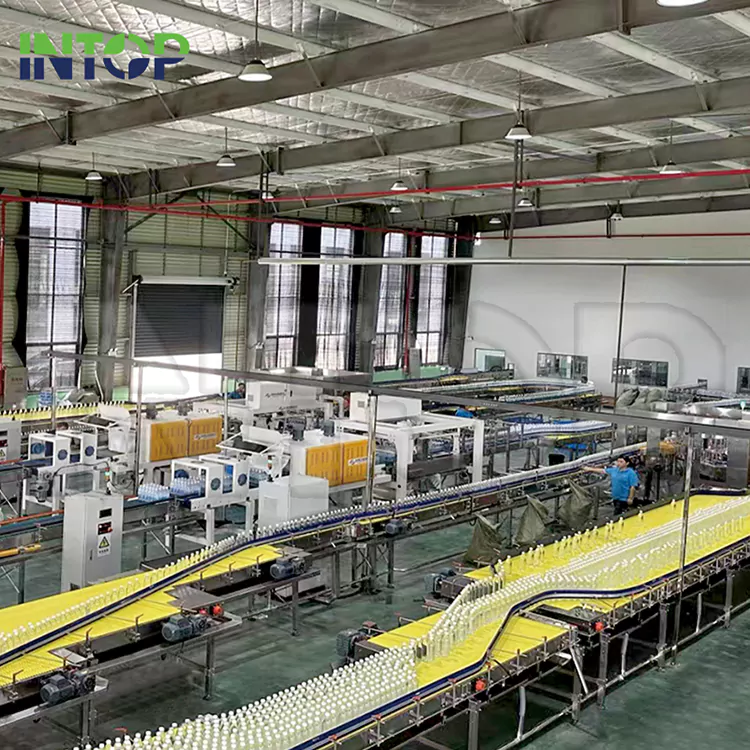
Why Do So Many Beverage Projects Stall After the First Successful Batch?
If you’ve ever nailed a product in R&D but struggled in real production, you’re not alone. Most beverage issues don’t show up in small tests—they appear at speed, under heat, pressure, and time constraints.
- Inconsistent taste when mixing, heating, or holding times vary across shifts
- Microbial risk when cleaning routines are hard to standardize
- Foaming and carbonation loss when transfer and filling aren’t optimized
- High scrap rates from unstable filling levels, capping defects, or bottle handling issues
- Slow changeovers that make seasonal SKUs or multi-flavor lines painful
In my experience, a well-designed Beverage Production Line solves these issues by controlling variability—on purpose, not by luck.
What Should a Beverage Production Line Control If You Care About Quality at Scale?
I like to break it down into “control points.” If a line can keep these stable, quality becomes predictable.
| Control Point | What Goes Wrong When It’s Weak | What I Look For in a Strong Line |
| Water treatment | Flavor drift, haze, mineral-related scaling | Stable filtration and treatment matched to recipe needs |
| Mixing and dissolution | Settling, sugar burn, uneven sweetness or acidity | Consistent mixing energy and repeatable dosing control |
| Thermal processing | Overcooking, underprocessing, shelf-life failures | Accurate temperature control and stable holding time |
| Sanitation and CIP | Downtime, contamination risk, chemical waste | Clear CIP flow path design with repeatable cycles |
| Filling and capping | Leaks, underfills, foam overflow, rejects | Fill stability, cap torque consistency, smooth bottle handling |
| Labeling and packing | Mislabels, rework, shipment delays | Stable alignment and integration with downstream packing |
When these are engineered to work together, a Beverage Production Line stops feeling like “a chain of separate machines” and starts behaving like a single production system.
How Do I Decide Between Semi Automatic and Fully Automatic Lines?
I don’t start with “automatic vs manual.” I start with your bottleneck. If you’re already losing time on operator-dependent steps—like inconsistent filling checks or repetitive handling—automation pays back quickly.
- Semi automatic makes sense when volumes are moderate, SKUs change frequently, and you need flexibility with limited floor space.
- Fully automatic becomes attractive when labor cost, speed, and standardization matter more than frequent reconfiguration.
What I’ve seen work well is a staged approach: upgrade the most variable step first (often mixing, CIP stability, or filling), then integrate upstream and downstream as volume grows. A scalable Beverage Production Line should support that evolution rather than forcing a risky all-or-nothing leap.
Which Beverage Types Usually Need Different Engineering Choices?
Not all beverages behave the same at speed. Here’s how I think about it when mapping a line.
| Beverage Type | Common Production Challenge | Line Feature That Helps |
| Juice and nectar | Pulp settling, haze control, oxidation | Stable mixing, oxygen management, reliable sanitation |
| Tea drinks | Aroma loss, color drift, sediment | Gentle processing control and consistent filtration choices |
| Carbonated beverages | Foaming, CO2 loss, fill instability | Pressure-aware transfers and filling stability at speed |
| Dairy based drinks | High microbial risk, fouling, cleaning time | Strong CIP design and stable thermal processing |
| Functional drinks | Precise dosing, ingredient sensitivity | Repeatable metering and controlled mixing sequence |
This is exactly why I like evaluating a Beverage Production Line as a recipe-specific system. The “best line” is the one that makes your product easier to repeat—every day, every shift.
What Practical Questions Should I Ask Before Buying a Beverage Production Line?
If you want to avoid expensive surprises, I’d push for answers to questions that reveal the real-world operating picture.
- Can the line hit my target output while keeping stable fill accuracy and low reject rates?
- How long is a typical flavor changeover, and what steps require manual verification?
- How is CIP designed, and how repeatable are the cleaning cycles across shifts?
- What utilities does the line realistically need at my desired speed?
- How does the system support future expansion, like adding new bottle sizes or packaging formats?
When a supplier can answer these clearly, it usually means the Beverage Production Line has been built with operational reality in mind—not just showroom specs.
How Can an Integrated Line Reduce Downtime and Operator Stress?
Here’s the honest truth: many “downtime problems” are actually “handoff problems.” Every time product moves from one step to another, variability sneaks in—unless the integration is intentional.
What I’ve observed in well-integrated projects (including the ones where INTOP is part of the solution) is that teams stop fighting the line and start running a routine. That usually shows up as:
- More predictable start-ups and fewer mystery alarms
- Cleaner sanitation scheduling with less guesswork
- Fewer rejects from bottle handling and capping inconsistencies
- Less operator fatigue because the workflow is standardized
And when your operators aren’t constantly improvising, the entire Beverage Production Line becomes easier to manage, audit, and scale.
Are You Ready to Build a Beverage Production Line That Scales Like a System?
If you’re trying to increase output without gambling on quality, I’d treat your next Beverage Production Line decision like a long-term operating strategy, not just a purchase order. If you want to discuss your beverage type, target capacity, packaging format, and how an integrated solution could fit your plant, contact us and share your project details. I’ll be happy to help you map a practical path from today’s bottleneck to a line that runs smoothly at scale.