

What Factors Influence the Configuration and Cost of a Custom Stainless Steel Food Truck?
2026-11-02
A first-time food truck buyer asks for a price before describing the menu. The builder cannot answer, because the price of a Hamburg Food Trailer is determined by the equipment and the layout, and the equipment and the layout are determined by the menu. A truck that sells coffee and pastries needs a different configuration from a truck that sells fried chicken and burgers. The first needs a small espresso station and a display case. The second needs a fryer, a hood, a fire suppression system, and a larger power supply. The difference in cost can be 60 percent or more. This guide explains the factors that influence the configuration and cost of a custom stainless steel food truck.
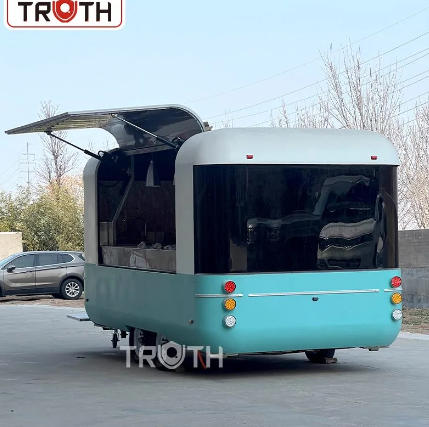
1. Why Does the Menu Decide the Layout Before Any Equipment Is Chosen?
The menu determines the equipment list, and the equipment list determines the workstations. Each workstation requires a certain width along the service counter and a certain depth behind it. A fry station requires 800 to 1,000 millimeters of counter width for the fryer plus a landing area. A griddle station requires 600 to 900 millimeters. A prep station requires 600 to 800 millimeters. The sum of the workstation widths, plus the aisles and the storage, determines the body length. In our factory, we start every custom Hamburg Food Trailer project with a menu review. We ask for the number of items, the cooking method for each item, and the expected orders per hour. Qingdao Truth Technology Co., Ltd. has been building food trailers for over 12 years.
The menu also determines the utility load. A menu with fried items requires a larger exhaust hood and a fire suppression system. A menu with espresso requires a water filtration system and a dedicated circuit for the espresso machine. A menu with frozen items requires a freezer and a larger power supply. The buyer who starts with the price instead of the menu usually ends up with a truck that is either undersized or overpriced for the actual operation.
2. Which Equipment and Utility Choices Drive the Largest Cost Differences?
The cost of a custom Hamburg Food Trailer is driven by five equipment and utility categories. The first is the cooking equipment. A single griddle is less expensive than a combination of fryer, griddle, and range. The second is the exhaust and fire suppression. A commercial hood with a fire suppression system costs significantly more than a simple exhaust fan. The third is the power supply. A generator, a shore power connection, or a dual system changes the electrical cost. The fourth is the water system. A cold water tank with a hand sink is less expensive than a hot water system with a grey water tank and a water heater. The fifth is the refrigeration. A single under-counter refrigerator is less expensive than a combination of refrigerator, freezer, and prep cooler. The table below shows the typical cost range for these categories.
| Configuration category | Basic option | Full option | Typical cost range |
| Cooking equipment | Single griddle | Fryer + griddle + range | $4,000 – $18,000 |
| Exhaust and fire suppression | Simple exhaust fan | Commercial hood + fire suppression | $2,500 – $12,000 |
| Power supply | Shore power only | Generator + shore power + ATS | $3,000 – $15,000 |
| Water system | Cold water + hand sink | Hot water + grey tank + water heater | $1,500 – $6,000 |
| Refrigeration | Single under-counter fridge | Fridge + freezer + prep cooler | $2,000 – $9,000 |
In our factory, we prepare a line-item quote for each category so that the buyer can see the cost of each choice. Truth does not use a single lump-sum price, because the lump sum hides the trade-offs that the buyer needs to understand.
3. How Do Chassis, Body Length, and Stainless Steel Grade Affect the Base Price?
The base price of a Hamburg Food Trailer is determined by the chassis, the body length, and the stainless steel grade. A towable trailer chassis is less expensive than a self-propelled chassis, but it requires a tow vehicle. A longer body increases the material cost and the weight, and it may require a heavier chassis and a larger tow vehicle. The stainless steel grade affects the cost and the corrosion resistance. Grade 304 is the standard for food contact surfaces. Grade 316 is more expensive, but it is more resistant to chlorides and to acidic foods. The table below shows the typical price impact of these choices.
| Choice | Basic option | Upgraded option | Typical price impact |
| Chassis type | Towable trailer | Self-propelled | + $8,000 – $25,000 |
| Body length | 3.5 meters | 5.5 meters | + $6,000 – $14,000 |
| Stainless steel grade | 304 on food contact surfaces | 316 on all surfaces | + $2,500 – $7,000 |
| Wall and roof insulation | Standard 30 mm | 50 mm for cold climate | + $1,500 – $4,000 |
| Floor construction | Standard plywood with vinyl | Sealed stainless steel floor | + $1,200 – $3,500 |
Food truck builder's note: The stainless steel grade is often the place where a low quote hides a cost reduction. A quote that uses 304 on the visible surfaces but galvanized steel on the interior walls will look the same on the showroom floor, but it will corrode faster in the kitchen environment. In our factory, we specify the grade for each surface in the quote, and we do not substitute a lower grade without the buyer's written approval. Truth provides a material schedule with each quote.
4. Why Do Compliance, Climate, and Site Conditions Add Cost That Buyers Often Overlook?
The compliance requirements vary by city and by state. A food truck that operates in a city with a strict fire code may need a fire suppression system, a fire-rated wall, and a labeled hood. A food truck that operates in a jurisdiction with a strict food code may need a three-compartment sink, a hand sink, and a mop sink. These items add cost, and they are often not included in a basic quote. The climate also adds cost. A truck that operates in a cold climate needs insulation, a heater, and freeze protection for the water system. A truck that operates in a hot and humid climate needs ventilation and corrosion protection. In our factory, we collect the operating location and the local code requirements before we prepare the quote. Qingdao Truth Technology Co., Ltd. has a compliance checklist for each state and for the major cities in our export markets.
The site conditions also matter. A site with a limited power supply may require a generator, which adds cost and requires a fuel storage area. A site with a limited water supply may require a larger water tank. A site with a sloped surface may require a leveling system. These conditions are not visible in the truck itself, but they change the configuration and the cost.
5. How Should Buyers Specify and Verify a Custom Food Truck Quote?
The specification should include seven items. The first is the menu and the expected orders per hour. The second is the equipment list with the brand and model of each item. The third is the utility configuration, including the power supply, the water system, and the exhaust. The fourth is the body length and the chassis type. The fifth is the stainless steel grade for each surface. The sixth is the compliance requirement for the operating location. The seventh is the delivery and commissioning scope. The verification should include four checks. The first is a line-by-line review of the quote against the specification. The second is a power balance calculation to verify that the generator or the shore power can carry the connected load. The third is a water balance calculation to verify that the tank capacity matches the daily usage. The fourth is a factory acceptance test before shipment. In our factory, we perform these checks for every custom Hamburg Food Trailer and we provide the calculation sheets with the quote.
We recommend that the buyer compare quotes on a like-for-like basis. A quote that is 20 percent lower may be missing the fire suppression, the water heater, or the 316 stainless steel. The buyer should ask for a line-item breakdown and should compare each line with the specification.
Frequently Asked Questions About Custom Stainless Steel Food Truck Configuration and Cost
Summary for Food Truck Buyers and Operators
The configuration and cost of a custom stainless steel food truck are determined by the menu, the equipment and utility choices, the chassis and body, the stainless steel grade, and the compliance and climate requirements. The menu should be defined first, because it drives the equipment list and the layout. The quote should be prepared as a line-item breakdown so that the buyer can see the cost of each choice and compare it with other quotes. The buyer should verify the power balance, the water balance, and the compliance items before signing the contract. Qingdao Truth Technology Co., Ltd. has been building food trailers for over 12 years and provides full configuration and quote verification support for our customers.